

Drawing Julia Greeley
The Work It Takes to See as Jesus Sees
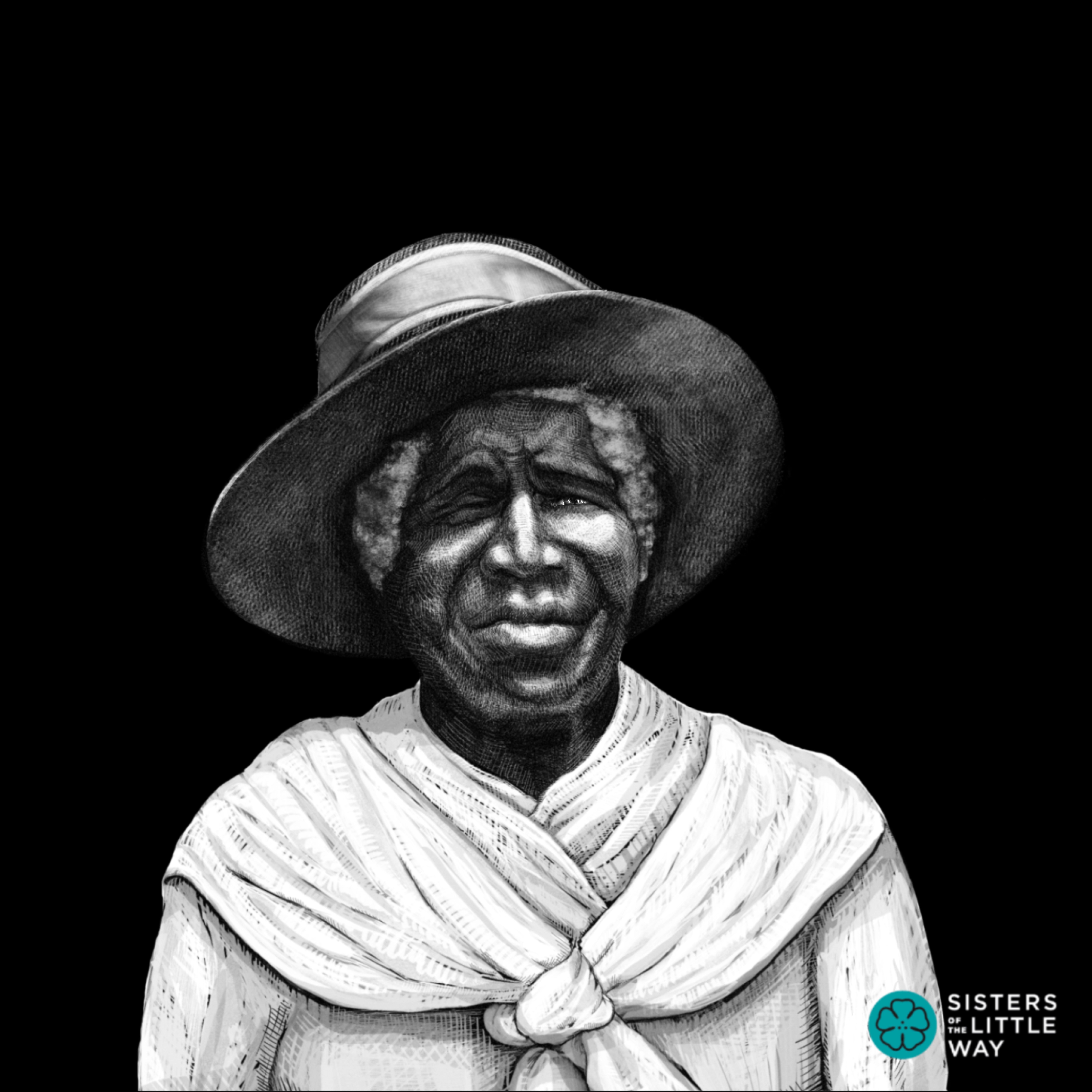
I have gained such solace from the Saints who have sought Christ with reckless abandon throughout history. Bringing the difficult experiences of my own life’s journey to prayer sensitizes me to the gift of our heavenly heritage. The lives of the Saints are a treasure not because we possess in them a mold from which to cast other Saints nor to contort ourselves into for reshaping, but more significantly, they are a prized specimen of humanity offered in freedom for our own loving dissection and scrutiny.
As humans, we tend to hold ourselves and others suspect—we are often small-minded and lacking in most virtues, especially faith. I am certainly prone to this. And I must admit the particular verse in the Litany of Humility that pangs me most speaks of “the fear of being suspected.” I surrender this fear in prayer again and again.
The Saints provide hope in the face of our neediness and want because they have offered their lives, some in a hidden way and others made visible by God’s will, revealing over time a human life permeated by the transforming love of God. Their testimony and witness are offered in complete surrender rather than by human effort alone. Pope Benedict XVI once wrote, “The only really effective apologia for Christianity comes down to two arguments, namely the saints the Church has produced and the art which it has grown in her womb.” We need both right now in the Church, and we are especially desperate for saints.
For this reason, I love to draw the Saints: their faces, slumped shoulders, eyes dignified by suffering, weather-creased and joy-filled wrinkles, the embodiment of their idiosyncratic personalities taken up in Christ. I enjoy drawing from photographs for this reason because these artifacts are like relics of the modern age. A hole punch from the book of salvation history, photos hold their humanity like a time capsule made present in a more stark way than iconography, which veils to reveal the sacred. As I stare at the faces and bodies of the Saints for hours while I draw, holding the stories their features speak, it feels like I am glimpsing Christ’s face. In this veneration, I can adore my living Lord incarnate in the face of history, which gives me new hope for every circumstance. Through them Christ speaks anew, “You are not alone. I am faithful. I am with you. Nothing is impossible for God. You are precious to me.”
During these days I have been drawing closer to Servant of God Julia Greeley. I am asking the Lord for a share in her detachment from honors and for magnanimity in the face of being held suspect. Who was this former-slave-turned-philanthropist convert who lived in Colorado during the mid-to-late 1800s? And how, O Lord, did she live so freely? And love so indiscriminately, even to the point of humbly giving her own gravesite to a poor stranger? How did she demonstrate such magnanimity to beg for the poor during the day and deliver charity under the cover of night, sparing those she served the social stigma that would have been wrongly placed on anyone aided by a Black woman? Despite her joy and generosity, her presence made people uncomfortable. Perhaps it was her race, the fact that she only had one eye, or that she unabashedly called others into sacrificial giving in every interaction.
Either way, it’s easy to take in the facts and draw the general shape of her without seeing her exactly, and I did this. I spent weeks drawing her face, but something was missing. Her gaze in my drawing seemed a bit vacant, harsh, and somewhat distorted. I had to spend a lot of time looking and relooking, stepping away from drawing what I thought I saw and truly look at the photograph. What made her alive? What is creating the distortion? I studied the light and proportions. I made adjustments that helped and everything seemed to be in place, but her quiet gentleness and joyful knowing was missing.
Finally, midway through a retreat at a monastery, I was filled with a quiet peace and simplicity before the Lord. I was praying to Julia Greeley for a very difficult situation that we were going through. I looked at the photograph I was drawing from again; it’s the only photo of her in existence. Blurry and over exposed, you can still sense the specificity of her character and a tremendous hope hidden almost entirely behind her eye. Looking at my drawing and her image side by side, it became apparent that the spark that enlivened her features was packed into one line. A convex line I had rendered concave that held the weight of her drooping left eyelid. When I made the correction, all her gentleness, compassion, hope, strength, and magnanimity came forward. In the way she squinted from the light of the sun, I could now see how she reflected the Son of the Father.
That moment impressed me deeply and made me think about how much we miss if we are not able to see Christ in one another, as well as the work it takes to truly see as Jesus does.
What a beautiful rendering and reflection! I have had a devotion to Miss Julia for many years now. Such a humble servant. I'm praying for her to be canonized! Is there any chance you will turn that into a print or prayer card? I would love to have a copy to put up at home.
Beautiful writing, beautiful drawing!